
Scroll through TikTok comments, rap lyrics, or a heated group chat, and you’ll likely spot the word “opp” thrown around. You might wonder if it’s an insult, a joke, or something else entirely. Millions of people search for OPP meaning 2026 every month, trying to figure out exactly that.
The short answer: OPP usually means “opponent” or “opposition.” People use it to describe a rival, an enemy, or anyone standing against them or their group. The term traces back to hip-hop culture and African American Vernacular English, but social media pulled it into mainstream slang over the past several years. Today, Gen Z and Gen Alpha use it constantly — sometimes seriously, sometimes as a lighthearted joke between friends.
This guide breaks down OPP meaning 2026 in full detail. You’ll learn where the term came from, how different platforms and age groups use it, which misconceptions trip people up, and how to respond when someone calls you an opp.
OPP Meaning & Definition
At its core, OPP stands for “opponent” or “opposition.” People use it to label someone on the other side of a conflict, rivalry, or competition. That someone might be a genuine enemy, a rival crew, or — much more often in 2026 — just a friend being playfully called out.
Technically, OPP isn’t a true acronym the way NASA or LOL are. It functions more like a clipped spelling of “opp,” itself a shortened version of “opponent.” Spoken slang shaped this word long before texting culture picked it up, which sets it apart from typing-born abbreviations like BRB or TTYL.
The Two Faces of OPP
Context decides whether OPP carries weight or humor. In serious settings, calling someone an opp signals real conflict — a rival gang member, a genuine enemy, or someone actively working against you. In casual settings, however, friends throw the word around constantly without any real animosity behind it.
Picture this exchange: your friend eats the last slice of pizza you were saving, and you jokingly say, “bro, you’re such an opp right now.” Nobody takes that seriously. That flexibility explains why OPP spread so widely — it works equally well for genuine beef and harmless banter.
Language moves fast online, and OPP shows that pattern clearly. A word born from street culture and hip-hop lyrics eventually became one of the most recognizable slang terms among younger internet users by 2026.
Background: The Origin of OPP
OPP didn’t start on social media. It began decades earlier, rooted in African American Vernacular English and urban street culture across the United States.
From Street Slang to Song Lyrics
Communities used “opp” informally for years before mainstream audiences ever heard it. The term gained wider recognition through hip-hop music, where artists frequently referenced “opps” when discussing rivals, enemies, or people from opposing groups. Throughout the 2010s, rap lyrics repeated the word so often that casual listeners started picking it up naturally, even outside music circles.
Twitter and Instagram accelerated that spread in the late 2010s. Captions, memes, and casual posts started featuring the word, exposing it to audiences who had never encountered hip-hop culture directly. From there, TikTok pushed OPP even further into the mainstream during the early 2020s, turning it into everyday vocabulary for teens and young adults everywhere.
Why OPP Still Trends in 2026
By 2026, OPP had shed most of its heavier, conflict-driven roots for a large portion of its users. Younger generations frequently use it humorously now, applying it to minor annoyances, friendly rivalries, or inside jokes rather than actual hostility. That shift mirrors how slang usually evolves: a term starts within a specific community, spreads through music and media, and eventually gets reshaped by whoever adopts it next.
Its short length also helped fuel its staying power. Three letters type faster than “opponent” or “enemy,” and short words spread more easily across captions, comments, and fast-paced conversations.
Usage in Different Contexts: Chat, Social Media, and Professional Fields
Where you encounter OPP changes how seriously you should take it. The same three letters can mean very different things depending on the setting.
Everyday Texting
In one-on-one texts, OPP usually appears jokingly between friends. Someone might text “you’re being such an opp” after losing a friendly bet or getting teased. The tone stays light in these exchanges, and both people typically understand it as harmless banter.
Social Media and Comment Sections
Social platforms treat OPP more loosely. Commenters use it to describe sports rivals, gaming opponents, or even fictional villains in shows and movies. Memes frequently play with the word, stretching its meaning toward general playful opposition rather than anything hostile.
Professional Settings
OPP has essentially no place in professional communication. This slang term originated in casual, personal, and often confrontational contexts, so using it in a work email or client conversation would sound out of place at best and inappropriate at worst. Even in laid-back workplace chats, colleagues unfamiliar with current slang might misread it as a genuine accusation of hostility rather than a joke.
A simple guideline applies across all three settings: the closer the relationship and the more casual the space, the safer OPP becomes to use playfully. Formal or professional environments call for plain language instead, since the term carries too much risk of misinterpretation outside casual social circles.
OPP on WhatsApp, Instagram, and TikTok
Each platform shapes how people use OPP slightly differently, based on its audience and communication style.
WhatsApp conversations tend to involve people who already know each other well, so OPP usually appears as an inside joke. Friends might use it after a game night loss or a friendly disagreement, fully aware the word carries no real weight between them.
Instagram sees OPP pop up frequently in comment sections, especially under posts related to sports, gaming, or celebrity rivalries. Captions sometimes use it humorously too, like a caption reading “opp behavior” under a photo poking fun at a friend’s competitive streak.
TikTok arguably drives more OPP usage than any other platform. Trending audios, duets, and stitch videos frequently reference the term, especially around gaming content, sports commentary, and relationship drama. TikTok’s comment culture rewards quick, punchy slang, and OPP fits that mold perfectly.
Across all three apps, the underlying meaning stays consistent — opposition or rivalry — but the seriousness shifts. WhatsApp usage tends to stay personal and playful. Instagram usage often connects to broader cultural moments. TikTok usage moves the fastest and leans hardest into humor and trends.
Does OPP Have Meanings Outside of Slang?
Yes — and unlike some slang terms with fabricated “technical” definitions floating around online, OPP genuinely does carry other established meanings, just written differently and used in entirely separate contexts.
Ontario Provincial Police (OPP): This is a real, well-documented meaning. The Ontario Provincial Police, a major Canadian law enforcement agency, uses “OPP” as its official abbreviation. News reports, government documents, and official communications from Ontario, Canada use this meaning regularly, and it has nothing to do with the slang term.
Opportunity: In business and casual writing, people sometimes abbreviate “opportunity” as “opp” or “opps,” especially in sales and marketing contexts. A salesperson might mention “closing three opps this quarter,” referring to sales opportunities rather than rivals.
Out of Print: In publishing and book-collecting circles, “OPP” occasionally describes books or materials no longer in production. Collectors and booksellers use this shorthand when cataloging older or discontinued titles.
Capitalization and context typically separate these meanings from the slang usage. A police report referencing “the OPP” clearly points to the Ontario Provincial Police, while a lowercase “opp” in a text message almost always points to the slang meaning. Reading the surrounding context resolves any ambiguity quickly.
Common Misconceptions About OPP
Because OPP carries so many layers, from serious to playful to entirely unrelated professional meanings, misunderstandings happen often.
Misconception 1: OPP always signals real conflict. Most modern usage, especially among Gen Z, treats OPP as a joke rather than a genuine accusation. Assuming hostility every time someone uses it misreads the vast majority of casual conversations.
Misconception 2: OPP is a formal acronym. Unlike NASA or LOL, OPP started as spoken slang, not a deliberate abbreviation. That origin explains why it doesn’t have one single “official” spelled-out meaning the way true acronyms do.
Misconception 3: Only rap fans or urban communities use it. While OPP originated in hip-hop and AAVE, mainstream internet culture adopted it broadly by 2026. Teens across vastly different backgrounds now use the term casually, regardless of their connection to its origins.
Misconception 4: Calling someone an opp is always insulting. Tone and relationship context determine whether the word stings or amuses. Close friends often use it affectionately, while strangers or genuine rivals might mean it more pointedly.
Misconception 5: OPP only has one meaning. As covered above, legitimate non-slang meanings exist too, including the Ontario Provincial Police and business shorthand for “opportunity.” Confusing these entirely separate uses can lead to real misunderstandings in formal writing.
Recognizing these misconceptions helps you avoid overreacting to a joke or, just as easily, missing genuine tension when it does exist.
Similar Terms and Alternatives to OPP
OPP belongs to a wider vocabulary of rivalry- and conflict-related slang. Several related terms carry similar or overlapping meanings.
- Beef — refers to ongoing conflict or tension between people, often more serious than casual OPP usage.
- Hater — describes someone who criticizes or resents another person’s success, without necessarily implying direct rivalry.
- Enemy — the plain-language equivalent, used more formally and without slang connotations.
- Rival — a more neutral term, often used in competitive contexts like sports or gaming without any hostility implied.
- Opp squad / opp block — extended slang phrases referring to a group or territory associated with rivals, used more heavily in serious or street-culture contexts.
OPP stands out among these alternatives because of its flexibility. Where “enemy” and “beef” tend to signal genuine conflict, OPP slides comfortably between serious and playful depending entirely on tone and relationship.
How to Respond to Being Called an OPP
Your response should match the tone of how someone used the word. Overreacting to a joke — or brushing off a real accusation — both create unnecessary friction.
If a friend clearly uses OPP jokingly, light responses work best:
- “Relax, I’m not an opp 😂”
- “Fine, I’ll join the opp team then.”
- “Opp mode activated, watch out.”
If the tone feels more serious or you’re unsure of someone’s intent, a calmer, clarifying response helps:
- “What makes you say that?”
- “I’m not trying to be against you, what’s going on?”
- “Let’s talk about this instead of throwing labels around.”
Emojis often signal tone instantly. A laughing emoji alongside “opp” almost always indicates a joke, while a message with no emoji and a colder tone deserves a more careful, direct reply. When genuinely unsure, asking for clarification beats assuming the worst.
OPP vs. Similar Slang: Key Differences
Several terms overlap conceptually with OPP, but subtle differences separate them.
Compared to beef, OPP describes a person, while beef describes the conflict itself. You’d say someone “is an opp,” but you’d say two people “have beef,” making the two terms grammatically and conceptually distinct despite their related meanings.
Compared to hater, OPP implies active opposition or rivalry, while a hater simply criticizes from the sidelines without necessarily engaging directly. Someone can hate on you without ever becoming your opp.
Compared to rival, OPP carries a slightly more informal, street-culture-rooted tone, while rival works comfortably in formal writing, sports commentary, and professional contexts without sounding out of place.
Compared to enemy, OPP feels far more casual and flexible. Calling someone your enemy almost always signals genuine hostility, whereas calling someone your opp frequently means nothing more than a friendly joke.
Understanding these distinctions helps you choose the right word for the right level of seriousness, avoiding unnecessary drama or confusion in casual conversations.
OPP in Online Conversations and Dating Apps
Slang like OPP shows up in surprising places, including the early stages of online dating, where tone-setting matters heavily.
On dating apps, someone might jokingly call a match an “opp” after losing a trivia game or playful debate during a conversation. Used this way, the term signals flirtatious competitiveness rather than genuine conflict, and it can actually help break the ice by injecting humor into an early exchange. That said, using slang unfamiliar to your match risks confusion, especially with someone from a different age group or cultural background who might not recognize the term.
In broader online spaces like gaming communities and forums, OPP frequently describes literal opponents in competitive games. A player might type “opp secured the kill” during a match, using the term in its most literal sense — describing an actual adversary within the game itself.
Across both contexts, reading your audience matters most. OPP lands well with people already familiar with internet slang, but a clearer alternative avoids unnecessary confusion with someone new to current trends.
What Does “Opp” Mean in 2026?
The slang term “opp” generally means an opponent, rival, enemy, or someone who is considered to be against you. It is commonly used in social media posts, text messages, online conversations, music, and youth slang. The plural form is usually “opps,” referring to multiple rivals or opposing people.
For example, if someone says, “He’s my opp,” they usually mean “He’s my enemy” or “He’s someone I’m against.” Similarly, “Watch out for the opps” can mean being cautious around people viewed as rivals or enemies.
Opp Meaning in Chat
In texting and online chat, “opp” is usually a shortened slang term for opponent or enemy. Its exact meaning depends on the conversation. Friends may also use it jokingly to describe someone they are arguing with or competing against.
Example:
“Why are you talking to my opp?”
Meaning: “Why are you talking to someone I consider my enemy or rival?”
Opp Meaning on TikTok and Social Media
On TikTok and other social media platforms, “opp” is often used casually to describe a person who is against someone, has a conflict with them, or belongs to a rival group. The term can be serious in some contexts but is also frequently used humorously or exaggeratedly in memes and everyday online conversations.
Opp Meaning in a Relationship
The meaning can change slightly when “opp” is used in a relationship-related conversation. Someone might call another person an “opp” if they are perceived as a romantic rival, someone interfering in the relationship, or simply a person they dislike.
For example:
“That guy is my opp.”
This could mean that the speaker sees the guy as a rival, including a potential romantic rival, depending on the context.
Where Did the Word “Opp” Come From?
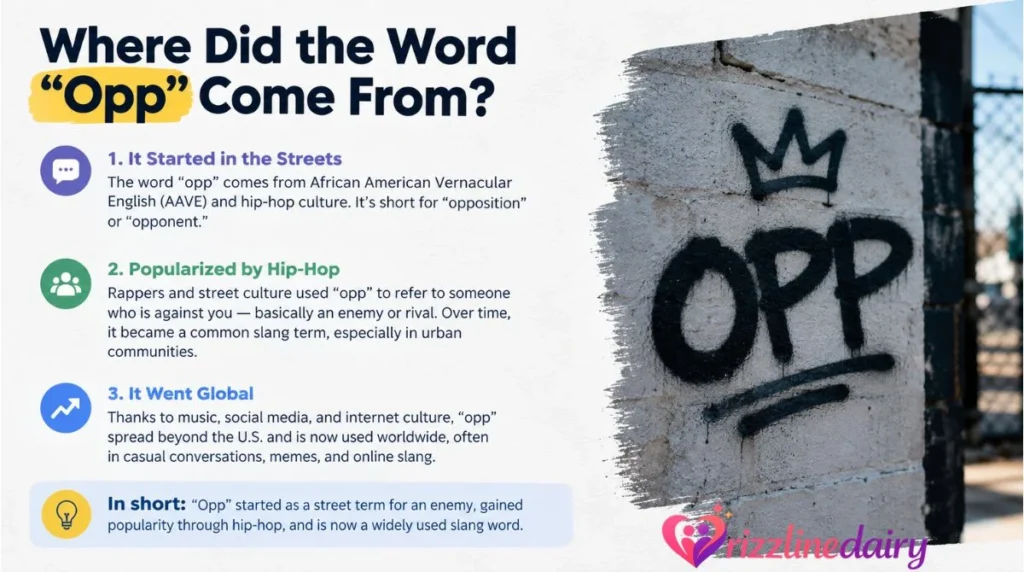
“Opp” is generally associated with “opponent” or “opposition.” The slang became especially prominent through hip-hop and street culture, where “opps” has been used to refer to rival individuals or groups. It later became much more widespread through music, memes, TikTok, and other social platforms.
Because slang evolves quickly, “opp” can have a broader or more playful meaning in modern internet culture than its original usage.
Opp vs. OPP: Are They the Same?
Not necessarily. “opp” and “OPP” can refer to different things depending on capitalization and context.
- opp — commonly means opponent, rival, or enemy in modern slang.
- opps — plural form, meaning rivals or enemies.
- OPP — can be an acronym with an entirely different meaning, including the well-known phrase from the 1991 Naughty by Nature song.
- In a particular conversation, OPP may also be used as an abbreviation for something unrelated to slang.
Therefore, the surrounding sentence is important when determining what “opp” means.
What Does “Opp” Mean in Urban Dictionary?
Urban Dictionary contains user-submitted definitions of slang, so entries for “opp” may vary. The common slang meaning is associated with an opponent, rival, or enemy, but individual definitions can use different wording or describe more specific contexts.
For an SEO article, it is better to explain the widely used meaning rather than rely on a single user-generated definition.
Examples of “Opp” in a Sentence
Here are some common examples of how people may use “opp”:
- “He’s an opp.” — He is considered an enemy or rival.
- “Don’t tell my opp.” — Don’t tell the person I’m against.
- “Why are you hanging out with the opps?” — Why are you spending time with my rivals?
- “That was my opp in the game.” — That person was my opponent.
- “We’re not opps anymore.” — We are no longer enemies or rivals.
Frequently Asked Questions
What does OPP mean from a girl? From a girl, OPP typically carries the same meaning it would from anyone else: an opponent, rival, or someone acting against her. Tone and context, not gender, determine whether she means it seriously or as a joke.
Is calling someone an opp offensive? It depends entirely on context and relationship. Among friends, it usually reads as playful teasing, while directed at a stranger or genuine rival, it can carry real hostility.
Does OPP always relate to hip-hop culture? The term originated in hip-hop and AAVE, but mainstream internet culture has broadened its use well beyond those roots. Millions of casual users in 2026 apply it without any direct connection to music or street culture.
Can OPP mean something other than slang? Yes — OPP officially abbreviates the Ontario Provincial Police in Canada, and informally stands for “opportunity” in business contexts. Capitalization and setting usually make the intended meaning obvious.
Is OPP still popular in 2026? Yes, OPP remains widely used, especially on TikTok and among Gen Z and Gen Alpha audiences. Trending videos, memes, and casual chats continue to keep the term firmly in everyday digital vocabulary.
Conclusion
OPP meaning 2026 comes down to one core idea: opposition. Whether it points to a genuine rival, a playful jab between friends, or an entirely unrelated term like the Ontario Provincial Police, context always decides how to read it. What started as street slang rooted in hip-hop culture has grown into one of the internet’s most flexible three-letter words, sliding effortlessly between serious conflict and lighthearted humor.
Understanding OPP means paying attention to tone, platform, and relationship rather than assuming a single fixed definition. Once you recognize those signals, you’ll never second-guess whether someone’s calling you an enemy — or just joking around after you ate their fries.

Basharat Ali is a content writer and humor specialist at RizzLineDairy.com with 3+ years of experience in viral content creation. He specializes in rizz lines, pickup lines, internet slang guides, and social media captions. His goal is to help readers communicate with confidence, charm, and creativity in every conversation.